
First of all
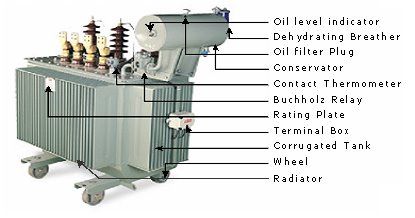


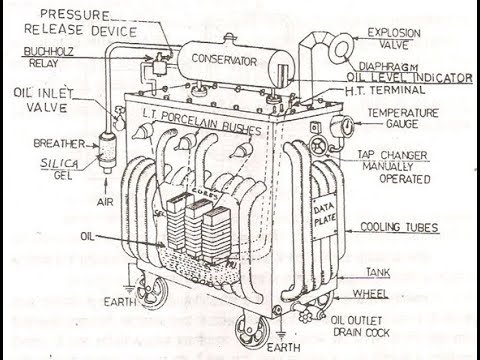
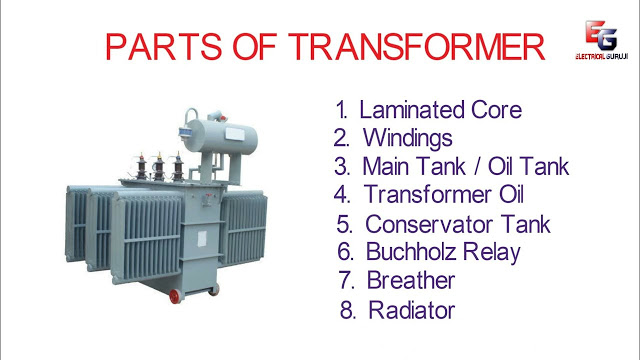
Let me tell you what transformer is, Transformer is an electrical device, Transformer Transfers electrical power form one electrical circuit to another electrical circuit.
While transformer transfers power we will observe there is no change in frequency of the power.
Transformer is the fundamental device that everyone should know about.

In this picture you can observe clearly the parts of a transformer
The main part of a transformer are
- Laminated core
- windings
- insulating material
- Transformer Oil
- Tap changer ( for Tapped Transformer)
- conservator
- Breather
- Cooling Tubes
- Buchholz Relay
- Explosion Vent

Windings of a transformer

Circuit diagram of a transformer
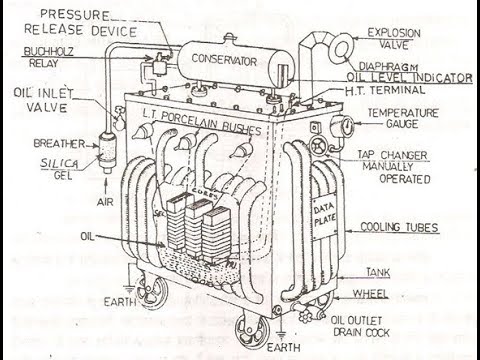

This is about what are the parts of a transformer
Now let us know the uses of each part in a transformer
1.Core
The core of the transformer is used to support the windings. It is made of soft iron to reduce eddy current loss and Hysteresis loss, and provides low reluctance path to the flow of magnetic flux. The diameter of a transformer’s core is directly proportional to copper loss and inversely proportional to iron loss.
Windings
Windings consist of several copper coil turns bundled together, each bundle connected to form a complete winding. Windings can be based either on the input-output supply or on the voltage range. Windings that are based on supply are classified into primary and secondary windings, meaning the windings to which the input and output voltage is applied respectively. On the other hand, windings based on voltage range can be classified into high voltage and low voltage windings.
Insulating materials
Insulating materials like papers and card boards are used to isolate primary and secondary windings from each other as well as the transformer core. These windings are made of copper due to high conductivity and ductility. High conductivity minimizes the amount of copper needed and minimizes losses. Moreover, high ductility results in easy bending of conductors into tight winding around the core that also minimizes the amount of copper and volume of winding.
Transformer oil
The transformer oil insulates as well as cools the core and coil assembly. The core and windings of the transformer must be completely immersed in the oil that normally contains hydrocarbon mineral oils.
Conservator
The conservator is an airtight metallic cylindrical drum fitted above the transformer that conserves the transformer oil. It is vented at the top and is filled only half with the oil to allow expansion and contraction during temperature variations. However the main tank of the transformer with which the conservator is connected is completely filled with the oil through a pipeline.
Breather
The breather is a cylindrical container filled with silica gel, which is used to keep the air that enters the tank moisture-free. This is because the insulating oil when reacts with moisture can affect the insulation and cause internal faults, which is why it is a must to keep the air free from moisture. In the breather, when the air passes through the silica gel, the moisture contents are absorbed by the silica crystals.
Tap changer
To balance voltage variations within the transformer, tap changers are used. There are two types of tap changers – on load and off load. In on load tap changers, tapping can be changed without isolating transformer from the supply, while in off load, the transformer needs to be disconnected from the supply.
Cooling tubes
As the name suggests, cooling tubes are used to cool the transformer oil. The circulation of oil within the transformer may be natural or forced. In the case of natural circulation, when the oil temperature rises, the hot oil naturally moves to the top and cold oil moves down, while in case of forced circulation, an eternal pump is used.
Buchholz Relay
Placed over the connecting pipe that runs from the main tank to conservator tank the Buchholz Relay senses the faults occurring within the transformer. It operates by the gases emitted due to decomposition of transformer oil during internal faults. Thus, this device is used to sense and in turn protect the transformer from internal faults.
Explosion vent
The boiling hot oil from the transformer is expelled during internal faults through the explosion vent to avoid explosion of the transformer. This is generally placed above the level of the conservatory tank.
Understanding all these parts of a transformer will help you understand transformers and their functions much better. With a wide variety of transformers available, you need to know which transformer type is the most suitable for you. However, for any kind of transformer purchase, you can get in touch with Miracle Electronics who manufactures the best-in-class power transformers in India since over the past 20 years and has been successfully supplying its products to over 20 countries across the globe
Source
Google
milacle.net.in
Thank you for visiting
share this to your friends
and let them to learn
 GPR Tech